7th Jan 2026
Chinese Guzheng: From the Ancient Tones of the Warring States Period to the Musical Movements of the New Era
Guzheng has been played in China for over two thousand years and remains popular. It is also a favorite among scholars and poets to convey their emotions. The "Night Guzheng" which written by Bai Juyi, depicts Guzheng's beautiful melody: "At the moment when the strings are still and the fingers stop, there are ten thousand layers of deep feelings." The variations in the Guzheng's volume and pauses convey deep emotions.
With the passage of time, the shape of the Guzheng has undergone many changes. The Guzheng is truly ancient, with its earliest origins dating back to the Warring States period. So far, the oldest Guzheng was discovered in Jiangxi Province. Additionally, a 13-string Guzheng from the Warring States period, unearthed in 1979, is over 2,500 years old. During the Warring States period, natural bridges made of branches were used to support the strings, and the pentatonic scale was used for tuning.

By the Tang Dynasty, the Guzheng had become more refined and beautiful, meanwhile it entered its golden age. It was widely used in court music. The Tang Guzheng had 13 strings and was similar to the modern Japanese Guzheng, because during this period, the Guzheng was introduced to Japan, and the Japanese Guzheng retained the original appearance of the Tang Guzheng. At the same time, the manufacturing techniques of the Tang Guzheng had made significant progress compared to those of the Warring States period, and the bridges were more similar to those of today's Guzheng. During the Tang Dynasty, the whole-digging technique and the folding board technique had already emerged.
During the Song, Yuan, Ming, and Qing Dynasties, the Guzheng became even more widespread. Different regions gave birth to distinct schools, such as the high-pitched and passionate Henan school, the vigorous and lively Shandong school, the elegant and refined Chaozhou school, and the simple and mellow Hakka school. These four schools have their own characteristics, enriching the history of the Guzheng with extremely important connotations. At this time, the 14-string Guzheng began to use the heptatonic scale for tuning. During the Qing Dynasty, the bridges of the Guzheng were relatively small, and in some regions, copper strings replaced silk strings, resulting in a brighter and clearer sound. The Qing Dynasty inherited the artistic essence of previous dynasties and more widely applied the Guzheng to folk music. Different playing techniques also gave the Guzheng different expressive capabilities.
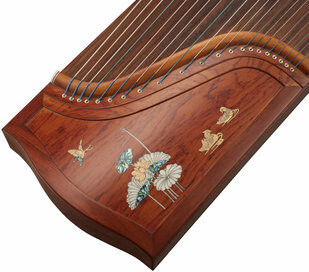
Entering modern times, the Guzheng has not faded with the passage of time. Starting from Mr. Xu Zhengao, we have developed the S-bend Guzheng, which not only broadens the range of the instrument but also makes the difference in timbre between the low and high notes more distinct. Artists have created many famous pieces while preserving traditional music, such as "Battle with the Typhoon" and "Lotus Song."
From folk songs to court music, from traditional ancient pieces to innovative adaptations, the Guzheng has always moved forward in the process of inheritance. With its unchanging oriental elegance, it has crossed mountains and seas, shining with renewed brilliance in the new era and sowing countless seeds of music around the world.