22nd Jan 2026
The Chinese Musical Instrument, the Guqin: Shaping Meaning through Form, Carrying the Essence of Eastern Culture
The form of the guqin is not merely a simple design of an instrument, but a condensed Eastern philosophical text. Every detail is imbued with profound philosophical thoughts and cultural connotations, embodying the concept of "harmony between man and nature" in a concrete form.
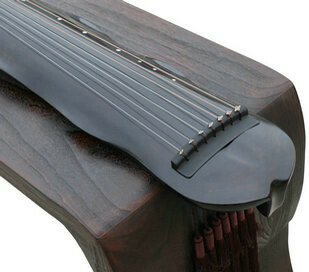
The guqin is approximately 1.2 meters long, symbolizing the 365 days of a year. The names of its components are full of poetic meaning. The curved surface represents the sky, while the flat bottom symbolizes the earth, reflecting the ancient belief that "the sky is round and the earth is square".
There are thirteen circular marks on the surface of the guqin, called "hui", inlaid with shells or jade, representing the twelve months of the year and one leap month. When playing, the notes are taken by pressing on these marks, as if measuring the sounds of heaven and earth on the scale of time.
Originally, the guqin had only five strings, symbolizing the five elements of metal, wood, water, fire, and earth, and corresponding to the ruler, minister, people, affairs, and objects. Later, King Wen of Zhou added a string to mourn his son, and King Wu of Zhou added another to boost the morale of his troops, eventually settling on seven strings.
The guqin has two sound holes on its underside, the larger one called "longchi" and the smaller one "fengzhao", symbolizing the sun and the moon respectively. One is round and the other is square, serving both for resonance and symbolizing the auspicious wish of the union of the dragon and the phoenix.
There are many common forms of the guqin, such as the Fuxi style, which has a round shape with two half-moon curves on the neck and waist. It has a broad and distant sound quality with a strong sense of depth, said to have been created by Fuxi, reflecting a reverence for nature. The Zhongni style is simple and smooth, with only concave lines on the waist and head, and no excessive decoration. Named after Confucius, it embodies the Confucian style of moderation and restraint. The Jiaoye style is named for its resemblance to a banana leaf, with elegant lines and a unique romantic charm of scholars. It is said to have been created by Liu Bowen. These forms are not designed randomly but incorporate natural laws and human rationality into the object, making the guqin a spiritual medium connecting heaven, earth, and man.

There is a subtle and profound resonance between the form and the musical scale of the guqin. The curves of the guqin's body are not only visually elegant but also acoustically wise. They determine the clarity of the harmonics, the depth of the pressed notes, and the vastness of the open strings, interweaving into the unique layers of the guqin's sound. The height of the yueshan, the opening and closing of the longchi and fengzhao, are all carefully considered within the tiniest margins, refined over thousands of years, echoing the scholars' pursuit of "serenity leading to far-reaching goals".
The form of the guqin does not merely exist for sound production, it is more like a bridge, connecting the most serene part of people's hearts. When the fingertips gently touch the silk strings, every curve and every dimension of the guqin's body silently guide the rise and fall of the gestures and the rhythm of the breath.