7th Jan 2026
The Benefits of Guzheng
Guzheng, with its twenty-one strings, carries the elegance and charm of a thousand years of Chinese civilization. It also plays a role as a bridge connecting Eastern and Western cultures on the international stage today, strumming the chords of cross-cultural exchange.
Guzheng originated in the Warring States period and was initially a five-stringed instrument made of bamboo. With the passage of time, its form has been continuously improved. For instance, it evolved to twelve strings in the Qin Dynasty, thirteen strings in the Tang Dynasty, fourteen strings in the Song Dynasty, sixteen strings in the Ming Dynasty, and eighteen strings in the Qing Dynasty.
Apart from being a musical instrument for playing, the guzheng, it also offers us significant benefits.

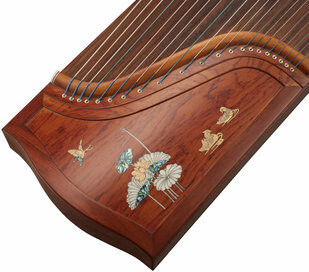
First, it nurtures artistic qualities and enhances aesthetic abilities. Long-term exposure to traditional Chinese music enables one to have a deeper perception of beauty. From the beauty of the guzheng's carved design to the beauty of its melodies and the beauty of traditional cultural connotations. Each piece is like a vivid oriental painting. When playing "Fisherman's Song at Dusk", the melodious tune floats through your heart, evoking the image of a setting sun and a small boat slowly crossing the lake. This is a feast of beauty. Moreover, the beauty of the guzheng's form should not be overlooked. The carvings on the head and tail of the guzheng are meticulously crafted by artisans. The guzheng itself is a work of art, and through constant exposure to it, learners can enhance their aesthetic abilities.
Second, it exercises the body and mind, fostering concentration and patience. In today's fast-paced and stressful life, playing the guzheng requires full immersion. Each melody demands focused attention and emotional resonance. This immersive experience can effectively alleviate anxiety and relax the body and mind. Learners must concentrate their entire attention on the music score, the guzheng, and the fingertips plucking the strings. The outside noise is thus blocked out. Over time, concentration will be significantly improved. There is no shortcut to learning the guzheng. One must take each step steadily, from correcting hand positions to controlling the strength, from practicing single notes to smoothly performing complete pieces, from initially not understanding the meaning of the music to eventually becoming one with it. Each step of growth is achieved through hard work behind the scenes.
Third, it enriches emotional expression and aids in emotional regulation. Learning the guzheng is not just about practicing finger techniques, it is also a dialogue with oneself. The focus of the rolling finger technique and the calmness when pressing the strings allow one to temporarily set aside fragmented trivialities and enter a state of total immersion. Each piece of music contains mountains, rivers, and moonlight. When playing "High Mountains and Flowing Water", learners need to understand the friendship between Boya and Zhong Ziqi. When performing "Ambush on All Sides", they must convey the atmosphere of the Chu-Han rivalry through the alternation of finger techniques. Throughout these processes, learners are gradually enhancing their ability to perceive emotions. Moreover, if one is in a low point, the frustration and pain accumulated in the heart can be gradually released with the vibration of the strings, regulating one's emotions imperceptibly.
From enhancing artistic qualities to cultivating the body and mind, and enriching emotions, guzheng has long been our teacher and friend, accompanying us on our long journey of life!