3rd Feb 2026
The Centennial Spread and Growth of the Guzheng in London
The development of the guzheng in London is a microcosm of its global expansion, marked by the imprints of cultural exchange and individual efforts.
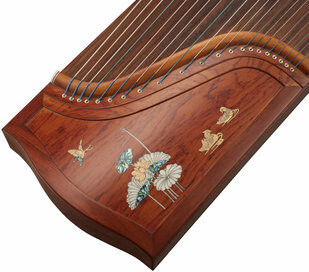
From the streets to concert halls, the spread of the guzheng in London has largely relied on the efforts and performances of individuals. Many Chinese students and artists have played the guzheng on the streets, in Chinatown, or in concert halls, attracting considerable attention from locals. These performances not only showcased the musical charm of the guzheng but also piqued the curiosity of foreigners about this instrument.
The guzheng's first encounter with London began in the early 20th century during the wave of Sino-Western cultural exchanges. In the 1930s, Chinese students brought portable guzhengs to London, initially only as a cultural anchor within the Chinese community, making occasional appearances at festivals in Chinatown. In 1956, the Victoria and Albert Museum in London held a "Chinese Art Exhibition", where the guzheng, as a representative of traditional Chinese instruments, made its debut on the British mainstream cultural stage. Its simple form and clear, resonant tones captured the curiosity of Western audiences. However, at this time, the spread of the guzheng was still in its infancy, lacking professional players and a teaching system, and it was more of a cultural symbol than a part of British society.
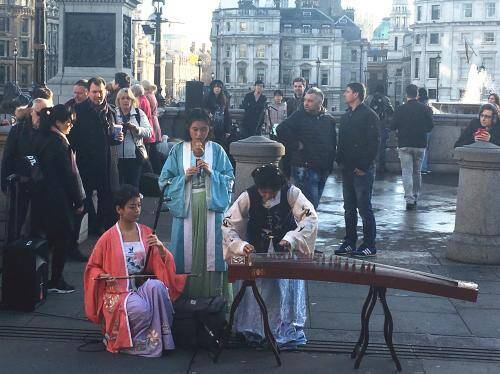
With the increasing frequency of cultural exchanges between China and the UK, the guzheng's development in London took a turn for the better. A group of professional Chinese guzheng players were invited to perform in the UK, injecting professional guzheng forces into London. As the popularity of the guzheng rose, learning and teaching gradually developed, forming a small community. Some guzheng-loving Chinese students seized this opportunity to establish guzheng societies in London, systematically promoting the instrument through teaching and performances. Additionally, the Confucius Institute in London included guzheng teaching in its Chinese culture lectures, making it an important part of spreading Chinese culture.
At the same time, private guzheng training institutions emerged, not only teaching playing techniques but also integrating cultural explanations to help learners understand the Eastern aesthetics behind the pieces. In the performance market, the guzheng was no longer limited to traditional solo performances but widely participated in cross-cultural collaborations. During the 2012 London Olympics, the guzheng's collaboration with a British brass band in the performance of "Echoes of the Silk Road" in the Olympic Village became a highlight of cultural exchange.
The development of the guzheng in London has long transcended simple instrument playing, it carries deeper cultural significance. The unique timbre and long history of the guzheng make it an excellent window for showcasing Chinese traditional culture to the world. Whether as players or learners, they are all telling the Chinese story in their own way. For those learning the guzheng in London, it is not just a skill but also a form of spiritual and physical cultivation.