9th Jan 2026
The Oriental Elegance Embodied in the Qin Instrument
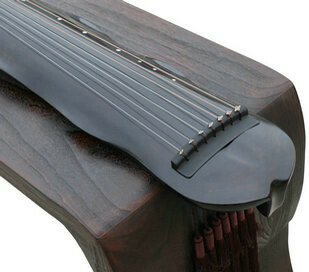
Among the four arts of "calligraphy, painting, chess, and qin", the qin, which refers to the guqin, with its seven strings, stands out as the first. It carries the spiritual pursuits of scholars, narrates a thousand years of history, and embodies the highest ideals.
The guqin is like an elderly man full of stories, facing you and recounting his long life journey. It is neither flamboyant nor inferior. In ancient times, playing the guqin was not merely a skill but a means of self-cultivation. Lighting a stick of incense, washing your hands, and eliminating external distractions were necessary to play the most touching melodies.
The temperament of the guqin is more in line with that of scholars. Its harmonics, produced by touching the strings with the left hand, are like a dragonfly skimming the water, while the right hand simultaneously plucks the strings, creating a clear and distant sound that sometimes seems to fade in and out, light and lively, like a voice from the heavens. The open strings, played with the right hand without pressing the strings with the left, have a deep and rich tone, forming the solid foundation of guqin music, symbolizing the earth. The pressed notes, created by pressing the strings with the left hand and plucking with the right, have a gentle and lyrical quality, smooth and delicate, like a tender woman expressing her feelings, symbolizing humanity.
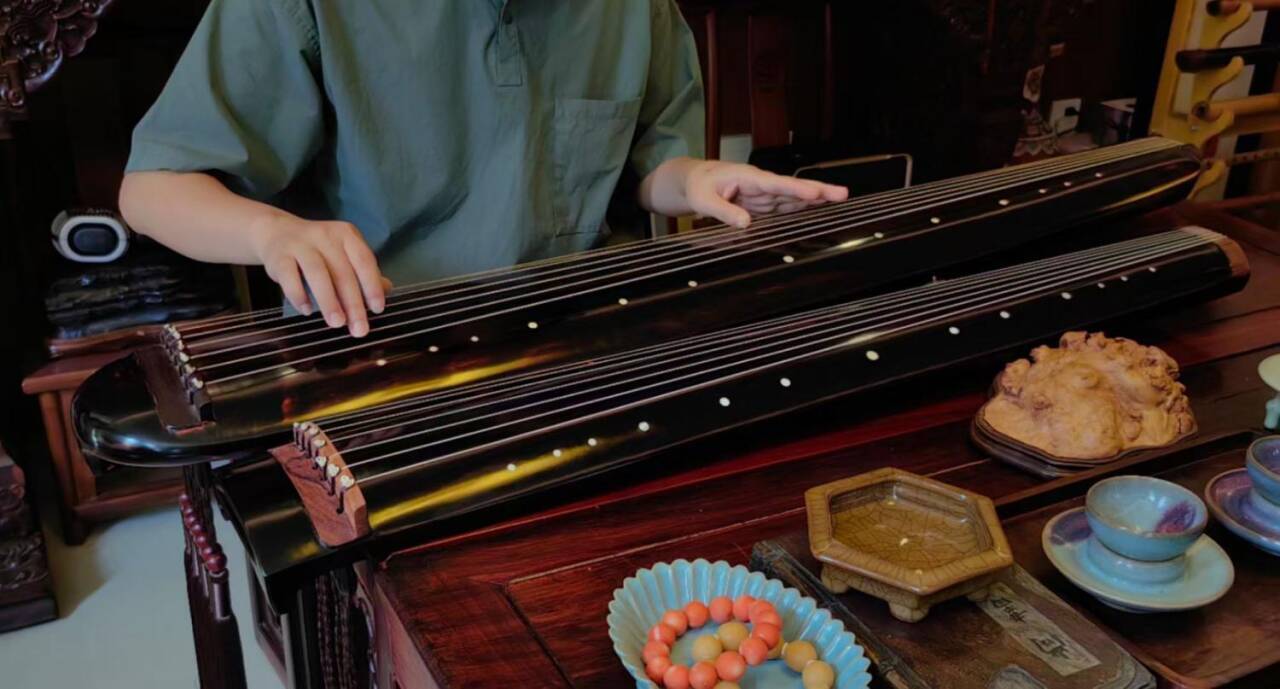
The interplay of these three tones can paint a beautiful picture of wandering through mountains and rivers. When Bo Ya played the guqin and met Ziqi, they found a lifelong friend through the piece "High Mountains and Flowing Water." This was not only a musical resonance but also a testament to the spiritual connection between scholars. For thousands of years, countless scholars and poets have used the guqin to express their frustration at being unrecognized and their inner feelings of indignation or heroic aspirations.
As early as the Tang Dynasty, the guqin embarked on the Silk Road. Whether in the flying apsara murals of the Mogao Caves, silk paintings, or the philosophical pursuits of Confucianism and Taoism in traditional culture, the guqin has always been present. Of course, the guqin has also integrated with Western culture. When Western symphony met the seven-stringed sound of the guqin, two completely different musical systems collided to create a more brilliant color. Many artists incorporated the tones of the guqin into symphony compositions, allowing the stability of the open strings, the ethereality of the harmonics, and the lyrical quality of the pressed notes to complement each other under the mutual illumination.
The cultural integration of the guqin is not a departure from traditional culture but a journey towards a farther and more beautiful future together with other cultures. With an unchanging cultural core, it adapts to the changes of the times and blossoms with unique flowers on different lands.
Every pluck of the strings resonates across the ages, engaging in a dialogue with us.