
2nd Nov 2026
The Sentiment of Guzheng: Meaning in One String
People often speak of the guzheng’s timeless grace and melodic depictions of mountains and rivers, yet few pause to wonder: of all Chinese musical instruments, why is this one stringed instrument called “zheng”? And why has it endured for over two thousand years, soothing countless souls?
The romance of the guzheng lies not in grand marketing of traditional oriental style, but in the delicate original intention hidden within the origin of its name.
The name “zheng” springs from its sound, shaped by its meaning, and woven through the passage of time. Its naming was not bound by complex rituals nor loaded with weighty allusions. It arose simply from the clear, ringing tone produced when its strings vibrate. The ancients named things plainly and sincerely, assigning names by the sounds they heard and forms they beheld. When fingers pluck the silk strings, the tone rings out steady, bright and lucid. Born in the Pre-Qin Dynasty, this plucked instrument was thus given the name “zheng”, which perfectly captures its unique timbre. As a pictophonetic character, its sound and meaning blend seamlessly; one single character conveys the essence of its tone.
The most widely known tale behind the name “zheng” comes from Book of Sui, recounting the legend of “dividing the se to create the zheng”. In ancient times, there was a fifty-string se, a large instrument with deep, rich tones. Legend says two brothers fought over one se and could not reach an agreement. Eventually they split the instrument in half, each keeping twenty-five strings. The divided instrument produced a bright, crisp ringing sound, entirely free of the se’s deep, heavy resonance, forming a unique timbre of its own. Drawing from this tale of contention, the ancients took the character “zheng (struggle)” as the base, topped it with the bamboo radical, and formed the character “筝”. Since its strings ring out “zheng-zheng”, the instrument came to bear this name. Though this folksy ancient tale may not be strictly historical fact, it reveals the core nature of the zheng: it was named for its sound. This simple character carries an elegant story that has endured for millennia.
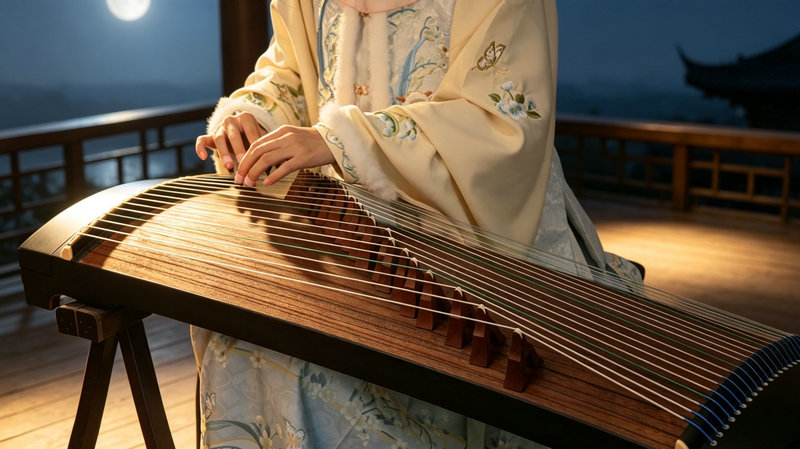
“Zheng” is a classic pictophonetic ancient character. The lower part “zheng” acts as the phonetic component and echoes the old tale of the divided se. But its true origin lies in the natural ringing vibration of strings. When slender fingers brush the strings, clear tones ring and linger. The ancients observed its shape and listened to its sound, naming the instrument for what they heard. This is the simple, poetic wisdom of our ancestors: naming things by their natural sound. Unlike many ancient musical instruments, defined by rituals and heavy conventions, the zheng came into being with pure simplicity. It began with a wisp of string music, a moment of hearing natural sound, a sincere and delicate capture of beautiful tones by the ancients.
Originally, it was known simply as “zheng”. The “gu” (ancient) in the modern term “guzheng” was not part of its original name.
For centuries, people called it only “zheng”. Born in the Pre-Qin era, thriving in the Qin and Han dynasties, flourishing in the Tang and Song dynasties, and passed down through the Ming and Qing dynasties, it remained “zheng” across thousands of years. Tang and Song poems, with lines like “Jade pillars chill against snow” and “Slender hands play the zheng in the moonlit chamber”, never use the compound name “guzheng”.
The prefix “gu” was added merely within the past hundred years. In modern times, Western instruments flooded in, bringing a wealth of new music. Looking back at this indigenous stringed instrument with a two-thousand-year legacy, people added the character “gu” to distinguish this traditional ancient instrument from modern modified ones and foreign instruments. This character “gu” does not imply obsolescence; it is a tribute to time. It marks the two-thousand-year-old string music with a unique Chinese imprint.
One name holds two layers of meaning; one sound carries the sentiment of a thousand years。
“Zheng” represents its origin, its first note, the pure inspiration of ancestors who named it after its sound. “Gu” embodies accumulation, remembrance, the glory forged by time. Compared with the quiet, solitary guqin and the passionate pipa, the guzheng carries a gentle, transparent nature from its very beginning. Calm and unassuming, its ringing strings comfort people amid mortal life. The difference of one character contains two eras. “Zheng” was the inspiration the ancients had when they first heard the string’s ring two thousand years ago; “Gu” is the footnote later generations bestowed upon this instrument in retrospect.
A small zheng body bears a name spanning a thousand years. People indulge in the landscapes and flowing melodies painted by guzheng music, yet the most touching elegance hides in the subtle details of its name. The ringing of strings settles across centuries. From naming it for its sound, to adding “gu” in later ages to honor its heritage, behind the name “guzheng” lies the most delicate and lasting inheritance of Chinese folk music.
Most admirers of the guzheng fix their eyes on the row of wild-goose-shaped bridges and warm paulownia wood, immersing themselves in scenes depicted in High Mountains and Flowing Water and Fisherman’s Song at Dusk. Few pause to examine its name. It carries no ornate implied meaning; its origin is merely the ringing echo of vibrating strings. From a single note, to one character as its name, to endless string music passed down for millennia — all the grand elegance we admire first arose from this tiny moment of hearing sound.
One ringing note forged a character; string melodies renew refined chapters across a thousand years. Elegance in music never lies in fame and grandeur, but in tracing the origin of a single character. When fingers brush zheng strings today and we hear that ringing tone, we connect across time with the ancestors who named it for its sound. One character records history; one instrument transmits charm. This ancient Chinese ingenuity embedded in its name flows onward together with zheng music, passed down from generation to generation.