
20th Nov 2026
The Sound Heart of the Erhu: Its Resonator
The resonator is the heart of an erhu.
Many players focus on bowing techniques and the sheen of strings, yet often overlook this hollow chamber — how it holds every vibration, lets the sound settle, and carries it far and wide. More than a simple wooden shell, the resonator is a vessel for resonance. It sets the fundamental tone of an erhu: deep and rich, bright and clear, or warm and lingering.
An erhu resonator follows its own delicate measure. Timber rests for a long time to shed its raw, fiery energy, then is carefully carved by artisans. The wall thickness and inner cavity shape are adjusted little by little. If the walls are too thick, sound gets trapped inside and cannot unfold freely. If too thin, vibrations come alive easily yet lack steady depth. No single template works for every piece of wood, for each has its own density. Artisans shape along the nature of the timber, so the chamber can catch vibrations from the strings and let the sound ripple out gently.
When the bow brushes the strings, vibrations travel to the snake skin and then into the resonator. A fine resonator blends all these vibrations together. Low notes are deep without muddiness; mid notes soft without emptiness; high notes bright without harshness. When playing mournful pieces, the tone flows slow and deep, like a quiet whisper. For lively melodies, the resonance springs alive, full of vigour. Thanks to this inclusive quality, the erhu can voice both heavy sorrow and bright joy, holding every shade of human feeling.
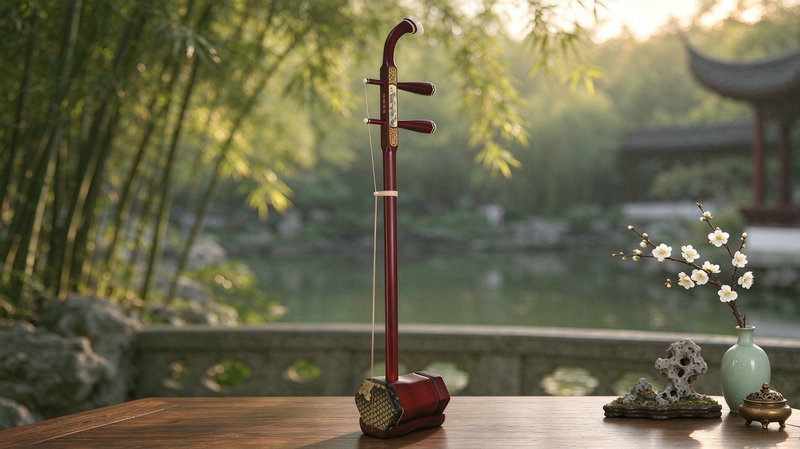
The patience of instrument‑making lives inside this small resonator. From selecting and cutting timber, to shaping the cavity and stretching the snake skin, no step can be rushed. After the skin is fitted, artisans test the sound again and again, tracing the flow of resonance and making tiny adjustments. A resonator is not merely a wooden casing; it is a home for sound. When resonance is balanced and transparent, the music gains both backbone and warmth.
As you play, there is a silent dialogue between you and the resonator. Fingers control the strings, the bow delivers force, and every emotion finally unfolds through the resonator’s resonance. The desolation of ancient melodies, the liveliness of folk tunes, and the freedom of modern compositions are all magnified and gently cradled within this compact space.
Years pass, and countless resonators ring with countless melodies. Choosing an erhu means feeling this vessel of resonance. It is not just wood and strings, but a small world that holds emotions and tells stories. When the bow falls and the strings sing, the resonator vibrates — every note carries the breath of human life.