
6th Nov 2026
The tone of a Xun instrument takes shape starting from its blowhole
Have you ever noticed the tiny blowhole at the top of a Xun instrument? On the entire Xun instrument, the blowhole is the first gateway for breath to enter the cavity. Minor differences in its size, curve and edge polishing will directly change how airflow moves into the cavity, ultimately affecting the brightness, responsiveness and air consumption of the tone. It is an extremely delicate part of Xun instrument craftsmanship.
Most blowholes of Xun instruments are made at the narrowed top of the cavity. Common shapes include U-shaped, V-shaped and small round openings. Pear-shaped Xun instruments mostly feature smooth U-shaped blowholes. It is far more than just a hole poked into the clay body. During the trimming process, craftsmen carefully polish the inner and outer edges of the blowhole. The outer edge has a gentle curve to fit the lips comfortably without sharp clay edges pressing uncomfortably against them while playing. The inner edge is softly chamfered to guide airflow smoothly into the cavity and prevent harsh hissing noise caused by airflow striking the inner side of the blowhole directly.
There are careful trade-offs when deciding the opening size of a blowhole. A wider opening allows easy air intake and requires less breath pressure, making it simpler for beginners to produce sound. However, the airflow tends to spread out, weakening cavity resonance. The tone becomes diffuse and hard to focus. A narrower opening concentrates airflow and delivers a full, solid sound with a stronger low-frequency atmosphere. Yet it demands precise breath control. Unstable blowing force can easily lead to whistling sounds or interrupted notes. Handmade Xun instrument craftsmen match the blowhole size according to the key and cavity volume of each instrument. The blowhole dimension of every single Xun instrument needs separate fine-tuning.
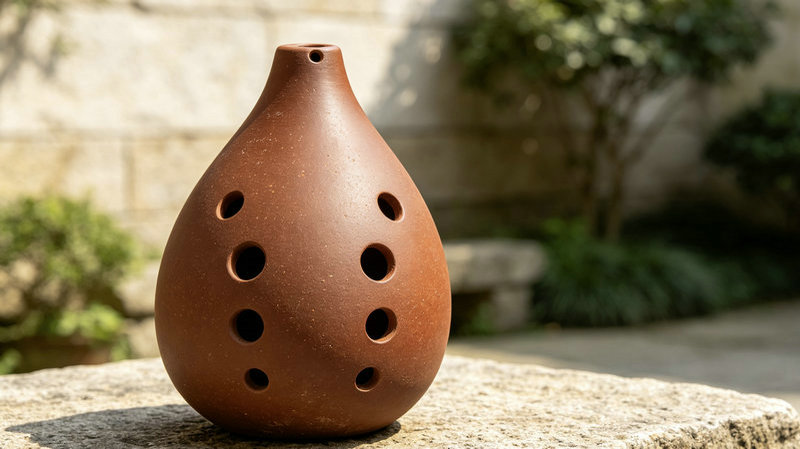
The tilt angle of the blowhole also follows acoustic principles. Instead of running straight vertically inward, the blowhole has an inward sloped surface. This slope guides airflow to swirl along the inner wall of the cavity rather than shooting straight toward the bottom. Airflow circulating along the inner wall can more easily set the whole air column inside the cavity into resonance, creating longer sound sustain. If the angle is too straight, airflow strikes the bottom directly, causing chaotic vibration. The tone turns short and dry, lacking the long, lingering reverberation unique to the Xun instrument.
Many low-cost mass-produced Xun instruments skip detailed polishing for blowholes. Their hole edges are rough without chamfers, and the angles follow fixed templates. Even if these Xun instruments have attractive outer shapes, they usually require more breath effort and produce plenty of unwanted noise. It becomes difficult to get a clean, soft tone. Fine handmade Xun instruments, by contrast, require hours of repeated adjustments on the blowhole. Craftsmen test the sound while trimming, refining the curve and opening bit by bit until the breath flows steadily into the cavity with rich, relaxed resonance.
The blowhole is only a small opening, yet it marks the meeting point between the player’s breath and the Xun instrument. The clay cavity holds the resonance, while the blowhole receives human breath and transforms it into the ancient, distant sound. This inconspicuous small spot is the vital link connecting the player and the instrument in Xun instrument craftsmanship.